

A Ratchet Lineage
What’s ratchet about thriving?

Dear Friend,
I am taking a break from my largely failed *hiatus* to share an exciting announcement:
The Ratchet Roundtable podcast is now live!
Ratchet Roundtable (RRT for short) is a show about the defiant, irreverent, unapologetic ways that everyday folks get free and thrive.
So far, we have one episode out. Five more will drop over the next several weeks, featuring an amazing lineup of guests.
This article goes with our first episode, “What’s Ratchet About Thriving?” where we talk about my Bridge to Thriving framework. Here, in this newsletter, I talk more concretely about the concept of ‘ratchet.’
As a scholar and a Black woman,1 it was important to me that this effort honor its cultural and academic lineage, so here’s an article about ratchetness, its influences, and how we are taking it up in the podcast. It’s longer than I’d like, but that’s because there is a lot to explore. I still don’t even come close to covering everything I could, but there are references at the end if you want to dig deeper. Maybe we’ll get SUPER lucky and some of the folks named below will agree to come on the show. *fingers crossed!*
Now this is an exploration of mostly Black innovation, but the lessons for thriving are for everyone. Nobody is coming out of the current world design unscathed. Everyone can join the project to heal, get free, and design a future worth having. Here is some guidance.
What IS Ratchet About Thriving?
We are here. We exist with various dimensions, live fully, and we continue to exist even when we cannot be readily seen, heard, or touched. We are permanent.2

Fundamentally, when marginalized people find ways to thrive, they use refusal, defiance, irreverence, disrespectability, and other ratchet ways of being. Oppression demands our compliance. We withhold it as a practice of getting free. We harmonize to the buzz of drones.
Let’s get into it.
Wretched
‘Ratchet’ is from the South—a “sonic derivation of ‘wretched’” stated “through clenched teeth and pursed lips.”3 Mmmhm. Raggedy, abject, lewd, loose, grimy, low-class, extra, and/or just plain unacceptable. An affront to the Black community’s reputation and a threat to racial uplift.4 A failure to be respectable. But that’s not all.
“Ratchet” is more than a word, it’s a concept, a culture, even an ethic or “politic of being.”5
You can BE ratchet and/or you can DO ratchetness on purpose.6 Folks use ‘ratchet’ to reject control, to claim their right to exist fully, to leverage people’s disapproval as a way to gain fame, and so on. It’s a complicated, powerful thing.
Here’s a fantastic treatment by Nikki Lane using E. Patrick Johnson and Alice Walker’s works as a guide:
Ratchet (ra-CHit), adj. 1. meaning wretched, raunchy, and/or raggedy; also, opp. of highbrow; having low taste, or tacky; from the African American Southern vernacular for wretched; sometimes negative in connotation; denotes a purposeful or careless excess of funk, attitude, filth, and/or grime. Antonyms, classy, professional, and boojie.
—adj. 2. socially unacceptable, and/or outside of norms within Black sexual and cultural politics and community; often used to describe a person who acts out and “acts up” intentionally, or not, with excess.
—adv. 3. lack of pretense, or care for socially acceptable standards; often used to describe an action performed with total disregard for propriety.
4. ratchet is to wretched as quare7 is to queer.8
Sesali Bowen, an entertainment writer, described ratchet as “an umbrella term for all things associated with the linguistic, stylistic, and cultural practices, witnessed or otherwise, of poor people; specifically poor people of color, and more specifically poor women of color.”9
In her show The (Mis)Adventures of Awkward Black Girl, Issa Rae defined ratchet as being “like if ‘ghetto’ and ‘hot shitty mess’ had a baby. And, that baby had no father and became a stripper, then made a sex tape with an athlete and then became a reality star.”10
Ratchet Goes Mainstream
By the early 2000s, ‘ratchet’ had been “transported on the backs of Southern hip-hoppers11 to the internet and to the mouths of people all over the country.”12 It quickly became a fixture of reality TV.13
In an American visual emporium that is both obsessed with being them (Black women) and obsessed with hating them, multimedia conglomerates, marketers, and Black women have found ingenious ways of capitalizing on those seemingly private sentiments about Black women. The popularity of these shows and the wide circulation of opinions about the Black women featured in them, demonstrate the American public’s disgust, rage, and/or “guilty pleasure” at watching Black women be “Black women” and tell intimate stories of their sexual lives.14
By 2012, the broad negative associations between ‘ratchet’ and Black women inspired Michaela Angela Davis’ Bury the Ratchet campaign—an attempt to address stereotypes and their downstream effects.15
Ratchet TV places in front of us the reality that Black women continue to occupy a place on the margins of even the most “glamorous” regions of Black life in America. The story remains the same—Black women are profitable, but they aren’t worth a damn. Black women get money, but only because they’re willing to sell sex for it. And yet, most Black women who strategically utilize ratchet ways of being, doing, and moving about the world couldn’t care less what you think, because they are living their best life.16
She’s So Ratchet!
Scholars including Robin Boylorn, Brittney Cooper, Aria Halliday, Nikki Lane, Heidi R. Lewis, Susana Morris, Ashley Payne, and Therí Pickens have looked closely at the ways Black women like Tamar Braxton leveraged the public’s desire for spectacle as a vehicle for power, wealth, and success; the power in choosing to let loose and drop the pretense of respectability; as well as the ways that women, “regardless of how ratchet or reckless [they] may act, have each other’s back when it counts and hold men accountable for their sexism and double standards.”17
Pickens described ratchetness as “a performative strategy that secures a liberatory space for Black women,” noting that it can be “a classed performance of cool…18 an evolution of terms like ‘crunk’ and ‘ghetto,’ both of which [simultaneously acknowledge and shed racial expectations].”19
The performance of ratchetness can be (and is) used to show a deliberate disregard for respectability. “It functions not only as a tool for pointing out and critiquing bad (Black) behavior, but also as a tool for those who are often already considered bad20 to resist the notion that what is ‘good’ and ‘bad’ must be based on what white people or Black middle-class people find acceptable.”21
Stephanie R. Toliver writes, “ultimately [ratchet] is ever-changing based on one’s desire to sustain or destabilize the politics of respectability.”22 Cooper goes so far as to name “a kind of disrespectability politics,” but I’m getting ahead of myself.
Let’s Talk About Respectability.
Part of the work that ratchet does is that it calls attention to the myriad ways that Blackness can be done. It also reveals the “pot,” or the boundaries of Blackness placed by those who are Black and those who are not.23
In Black communities respectability is about survival.24 It’s a strategy—an “assertion of Black humanity”25—developed over time, through crushing lived experience, that has allowed some ease of movement above, around, under, through, and between the pervasive, violent, life-or-death threats of white supremacy.
Respectability is a practice of coping—a cobblestone on the path toward thriving, perhaps, but not thriving itself. Why? Because it requires compromising freedom of expression, pleasure, and wholeness, among other devastating constraints.
According to Evelyn Brooks Higginbotham, respectability politics are “a range of strategies, largely regarding notions of honor, self-respect, piety, and propriety, developed by progressive [19th century] Black women to promote racial uplift and women’s rights to secure broader access to the public space.” Respectability was (and still is) concerned with standards around “sexual conduct, cleanliness, temperance, hard work, and politeness.26
One cost of respectability is that individual will, needs, and desires are subordinated to the larger community’s attempts at social and political uplift.27 Insiders police themselves and each other. Outsiders enforce limiting social norms through the lens of white middle-class culture, as institutions impose demands, pains, and punishments grounded in the surveillance, control, and self-abandonment required by that culture. Teresa Irene Gonzales also points out that “notions of respectability particularly ignore the limitations that Black women encounter when they attempt to conform to norms of whiteness.”28
The cost of failing to be respectable is palpable: exclusion, loss of status, loss of opportunity, violence, and even death—though premature death (fast or slow) is an ever-present threat, regardless.29 Take, for example, what happened to law professor Anita Hill in 1992. She was supposed to suffer in silence, but “even an upstanding middle-class Black woman… would garner mistrust and vitriol when she recounted the [abuse] that she’d been subjected to by now Supreme Court Justice Clarence Thomas.”30 Similarly, when Megan Thee Stallion was shot in July 2020, there was a highly visible, breathtaking lack of empathy from much of the public. Her body had been “marked as excessive, loud, disposable, and above all, deserving of whatever violence” it received. “As a ratchet Black woman who embodies purposeful lack of regard for Black middle-class norms concerning gender and sexuality, …she was ungrievable.”31
If someone has “made it,” in spite of the odds, they’re not likely to risk losing stability or progress. That said, and, as Ibram X. Kendi noted,
Everyone who has witnessed the historic presidency of Barack Obama—and the historic opposition to him—should now know full well that the more Black people uplift themselves, the more they will find themselves on the receiving end of a racist backlash. Uplift suasion, as a strategy for racial progress, has failed.32
But, we’re nothing if not “make a way out of no way” folks, so it’s Black women to the rescue (again) with new, more inclusive ways of being. Enter the claiming of ‘ratchet-respectability.’
Ratchet-Respectability & Disrespectability
Ratchet serves as a compelling site to think through the work that individuals do to perform a kind of anti-respectability that does not insist on acceptance from anyone, let alone a mainstream which would rather see them dying or dead anyway.33
Okay, now we can return to the work that Cooper and others have done to not only carve out social/scholarly space for Black women’s authentic selves, but to shift public discourse toward a broader understanding of our complex wholeness, our power, and our creativity.
Brittney Cooper explores the tensions between striving for the relative safety of respectability and how “our love for all things ratchet is as much about getting free as it is about reminding ourselves of all the reasons why we made the [respectable] choices we made.”34 But she goes on to ask the crucial question:
Are any of us winning in a scenario where respectable and ratchet are the only two options?
Cooper provokes us further, saying,
“We must ask what ratchetness itself makes possible… Are Black women not always already perceived as ratchet anyway?35 As over-the-top, excessive, doing the most and achieving the least, unable to be contained, except through wholly insufficient discourses like ghetto and hood and ratchet. And respectable. Are Black men ratchet? Can White women be ratchet? Is this ratchet?36
Scholars Robin Boylorn and Heidi R. Lewis also reject a rigid binary, noting that “respectability and ratchetness are capable of coexisting in the same woman at the same time.”37 We can see this in Megan Thee Stallion’s #HotGirlSummer and #HotNerdFall campaigns: “being loud, outspoken, sexual, and visible, particularly in male-dominated spaces, while boasting about the importance of education to the world and completing her bachelor’s degree—a sexually liberated, ratchet-demic.”38 Megan is multidimensional.
Other popular artists show us this same complexity: Doechii, Cardi B, Lizzo, Beyoncé, Janelle Monáe, and others demonstrate “confidence, dominance, beauty, and sexuality”39 as well as non-conformity and control over their presentations of self. Remember Serena Williams C-walking during the 2025 Super Bowl halftime performance to Kendrick Lamar’s “They Not Like Us”? Remember how she caught shit for doing something similar at Wimbledon back in 2012?40 Mmhm.
Nadia Brown and Lisa Young define disrespectability politics as a set of beliefs that ‘allow Black women to operate within the extremes of the queen-subject/ho-object framework that portray women in binaries and stereotypes.’ [...] Disrespectability politics… represent a conscious deviation from these norms.41
In other words, Black women are (once again) claiming their wholeness. They aren’t failing to be respectable, they are engaging in a “rejection of propriety,” a “disrespectability politics” that allows them “to push back against too rigid expectations of acceptable womanhood” and reject whitewashed race and gender performances.42
Lineage
What does it mean to “be yourself,” especially when you are not in control of the narrative placed around the circumstances of your life? … It feels like being a Black woman in America.43
We love ourselves even when we get no love. We recognize that we are our own best thing, our own best argument, and patriarchy’s worst nightmare.44
The #BlackGirlMagic movement was created by a woman who didn’t finish college, and had babies young, and grinded in menial jobs for years. This movement is for every black woman—the ratchet girls, the hood girls, the trans girls, the differently-abled girls. Black Girl Magic is for all of us. - CaShawn Thompson, creator of #BlackGirlMagic45
Tenet 1: My feminism is ratchet and so am I.
Tenet 3: I am free to be my whole self and nothing but myself.
Tenet 8: I will not hide hip-hop under my bed.46
We know we are beautiful. And ugly too.47
There’s a powerful lineage of resistance, creativity, and intellectual thought that undergirds the ‘ratchet’ we’re invoking in Ratchet Roundtable.
Ma Rainey, Bessie Smith, and Bessie Jackson (aka Lucille Bogan) were blues performers who sang about pleasure, sex, and self-determination without a hint of shame all the way back in the early 1900s.48 Just over a half-century later, I was listening to Lil’ Kim, The Lady of Rage, MC Lyte, Lauryn Hill, and Missy Elliott—getting my whole, empowered, ratchet Black girl life.
We can draw an ancestral line from the ‘dirty’ blues to Hip Hop feminism (HHF),49 which paved the way for crunk feminism, ratchet feminism, and Black girlhood studies, which has made the ground soft for THOT scholarship, which will inevitably open new portals. Thanks to Robin Boylorn, Brittney Cooper, Aria Halliday, Mariah Johnson, Cheryl Keyes, Treva Lindsey, Joan Morgan, Susana Morris, Ashley Payne, Gwendolyn Pough, and Tricia Rose, among others, we have an intergenerational archive that shows how art, culture, power, relationships, and representation have played out in the lives and works of Black women and girls over time.
In the beginning, we got CRUNK. At house parties…. In the club. And in the classroom. Crunkness was energy and life, fire and resistance, swagger and verve, going off and showing out. But it was also about showing up, for ourselves and for each other, in spaces that didn’t love us.50
Halliday and Payne (2020) state that “Hip Hop feminism celebrates women’s love for the culture and their battle for identity, representation, and respect.”51 Bettina Love adds that “hip hop feminism wrestles with Black and Brown girls’ life experiences as creators and consumers of hip hop, a contradictory space filled with the tensions of heteropatriarchal- and hyper-masculinity, [while also providing them] a space of agency.”52 Treva Lindsey includes “desire, pleasure, and play” in that agentic space, all things that respectable women and girls are expected to avoid.53 Indeed, the ethic of defiance that allows for reclaiming and redefining ‘bitch’ via HHF is the same one through which we transform ‘ratchet.’54
Coined by Brittney Cooper, HHF’s little sister ratchet feminism “‘critiques sexism and patriarchy in ratchet spaces while’ amplifying female friendships and communion among Black women, …and holding a space for the women who are written off by respectability politics.”55
Thus, it’s for all of us—“everyday Black women—including those who self-identify as ratchet, thots, baby mamas, gold-diggers, money-makers, bawse bitches, and haters.”56 Once again, we see a reclaiming of “controlling images of Black women” that have been, as Patricia Hill Collins wrote, “essential to the political economy of domination fostering Black women’s oppression.”57 Ratchet feminism refuses to accept such domination.
Mariah Johnson goes so far as to focus our attention on “embodied practices as paths to liberation,” Black women’s expressions of “physical joy,” and “the power of the erotic,” declaring that “twerking [is] the embodied practice of ratchet feminism.”58 She writes, “If respectability politics aspire to shrink Black people, especially Black women, then twerking resists this shrinking …twerking emerges as a defiant act.”59
Johnson (2024) also elaborates ratchet feminism toward thot scholarship, stating:
To be a thot scholar means to be ‘pro-heaux, anti-respectability, reject the idea of femininity as determined by genitalia, and reject the stigma attached to the erotic.’ Thot scholarship is ratchet feminism with an added element of a critique of respectability within academia.60
Ratchet Imagination
Grounded at the intersection of Hip Hop Feminism and Robin D. G. Kelley’s Black Radical Imagination61 we get L.H. Stallings’ Ratchet Imaginary. It uses refusal of respectability and “white, heteropatriarchal standards of identity” as a conduit for the free exploration of authentic selfhood.62 The Ratchet Imaginary then extended into Black Ratchet Imagination (BRI), “an imaginative, agentive, creative, performative, uplifting transitional space established and occupied by queer youth of color in the hip hop community to promote the ‘performance of the failure to be respectable.’”63 Stephanie Toliver elaborates that “BRI assumes that Black people who exist within the space of ratchetness redefine what it means to be and exist in a Black body. …It accepts expressions of Blackness that are unregulated by a white gaze, unfettered by the policing of behavior by Black community members, and unbothered by the artificial need to maintain a ‘respectable’ version of identity.”64
And, Bettina Love used BRI to articulate a methodology that:
recognizes and affirms the full humanity of Black queer youth for their sexual desires, multiple identities, economic status, style of dress, language, music, and dance; simply stated, a methodological perspective that acknowledges Black queer youth’s precarity but does not blame or shame them for it. It instead asks researchers to center the heritage, community, and audacity of youth to reclaim and make space for cultural practices birthed out of the need for “their imaginations’ nourishment for creating a world of freedom where they could be whoever they felt they truly were.65
Ratchetness as a Technology for Thriving
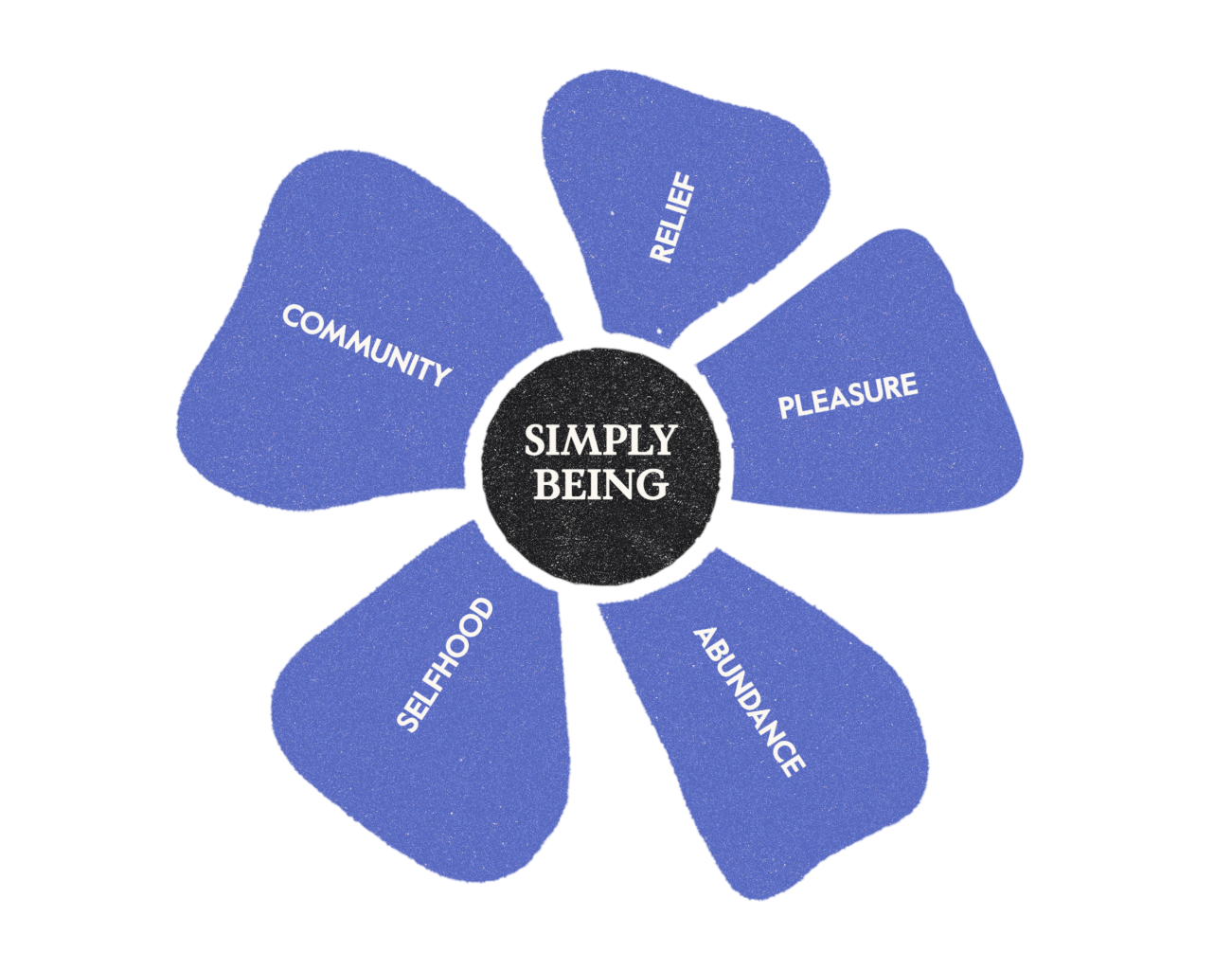
Bettina Love’s BRI methodology helped guide my dissertation research. It was that effort that birthed the Bridge to Thriving framework, which articulates six dimensions of thriving that map onto, and are informed by, the lineage explored above.
When we center the people pushed to society’s margins and we insist that their thriving is not only possible, but a right, it illuminates mindsets and practices that can otherwise be overlooked.
For example, all human beings can benefit from a strong, integrated identity and a sense of authentic selfhood, from confidence to a sense of self-efficacy to competence, and so on. However as we push out to the social periphery, we find increasing barriers tied to skin color, facial features, hair texture, body size, sex, gender, income, disability, etc. I mean, we’ve even had to weather the intergenerational pathologizing of liberation efforts: drapetomania, protest psychosis, oppositional defiance disorder, being labeled ratchet….66
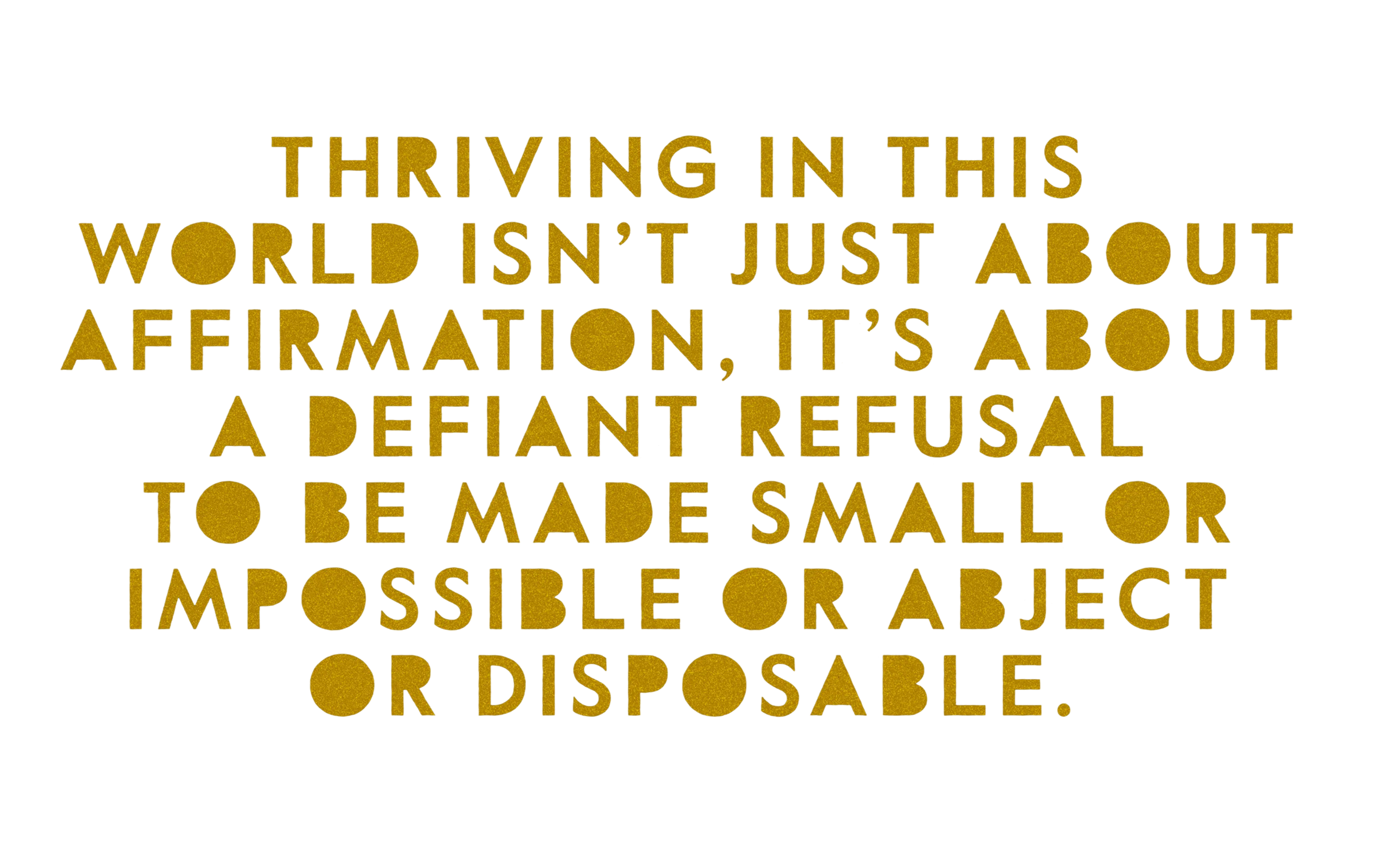
So, thriving in this world isn’t just about affirmation, it’s about a defiant refusal to be made small or impossible or abject or disposable. It’s about finding belonging and membership beyond those centered and privileged. It’s about claiming one’s own inherent dignity and right to exist, even in the face of the thousand cuts that slice at you from before the day you’re born. We see this in ratchetness: not seeking approval, refusing to be quiet, being disrespectable, claiming wholeness…
I get a little violent when I play the game of tag
I get a little quiet when I think about the bag
[...]
I tried to act smart cause I want a lot of friends
I never really went with the flow of the trends
I think I like girls, but I think I like men
Doechii is a d*ck, I never fit in
[...]
(Speak up, speak up, speak up, speak)67
Abundance as a dimension of thriving includes facing and telling the truth, even when it’s ugly or taboo. For example, ratchetness squarely faces the limitations of the respectability project and names its harms.
Abundance also includes imagination. It comes in the form of deep, critical love; of inventing hope every day (thank you James Baldwin and Angela Davis… lineage!); of dreaming and building beyond what we know. Abundance is embodied in the Crunk Feminist Collective and in Tamar Braxton’s ability to transmute spectacle into wealth-generating notoriety. It’s in Bessie Jackson’s unapologetic songs (and you’ll see the connection back to selfhood, claiming a love of sex and pleasure… claiming wholeness despite so many pressures not to).
A key, organizing principle that undergirds the entire ratchet lineage is pleasure. The pleasure we get from rapping along to “inappropriate” lyrics, the pleasure we get from twerking, the pleasure we get from finding sisterhood or chosen family, the pleasure we can find when we allow ourselves full access to the world… And, of course, once again this is a defiant pleasure. A refusal to be made small. A fiery insistence on Being. Fully.
Working our way around the Thriving Flower, we come to relief. In addition to the release that we get from letting go of rigidity, propriety, masking, and self-abandonment, there’s something relieving about finding our way back to ourselves, claiming wholeness, experiencing pleasure without shame, and so on. Even when the world conspires against us, ratchetness can offer an oasis—inside of us or our community or the “subversive and creative [humanizing] spaces” that we create.68 Additionally, one aspect of thriving that is particular to marginalized communities is activism and the relief it provides both by advancing solutions to problems and by giving people a way to resist. Resistance is a thriving practice. Teresa Irene Gonzales digs into this in her exploration of ratchet-rasquache activism among women of color in Chicago. She writes,
Emerging from African-American communities, “ratchet” connotes unruliness and low-class behavior. In Mexican communities, “rasquache” similarly connotes negative or low-class behavior but also means making the most with the tools one has. Both concepts, rooted in working-class sensibilities, can subvert narratives of racial uplift and reject normative whiteness as the standard for both activism and community development. Deploying “ratchet” and “rasquache” as positive attributes, Chicago-based women-of-color activists used nonhierarchical community-organizing tactics to operate as neighborhood strategists. Acknowledging the strength and expertise within marginalized, impoverished communities, they embraced a working-class, asset-based, ratchet and rasquache strategy, while striving to build something from something.69
And the common thread throughout all of it is community. Belonging is a fundamental human need, but finding belonging in a society that wants you to feel perpetually alien, in which even your own neighbors and family can take up that destructive project, is no small feat. When we talk about thriving at the margins, we need true belonging. This is not the same thing as fitting in, which is what respectability essentially offers. We need people who see us, love us, and reflect us back to ourselves warmly and authentically. We need mutuality and people who have our backs—people who struggle with us. This is part of the reason why affinity spaces are so important. The Combahee River Collective, the Crunk Feminist Collective, the scholars building the field of Black Girlhood Studies, and the vast population of fans who have found mirrors in Megan, Cardi, and Doechii songs are ratchet communities—dreaming together, finding pleasure, designing relief, anchoring each other’s spirits—in spite of, regardless, and unapologetically.
Finally, there’s a composite dimension of thriving that both stands alone and sits at the intersection of the other dimensions. It’s the ability to Simply Be. It’s a state that people seek all the time—the ability to just exist, to feel fully oneself, to be whole. Think about your life in the economic and political systems governing the world. Think about their demand for labor, productivity, grind, resilience… It’s giving status quo. It’s giving respectable. Recognizing that this machinery is human-made, that it’s not the only possible configuration for life, is ratchet.
“The politics of respectability is meant to compel us to invest so much of our daily existence into the management of what other people that we would deny simply being ourselves.”70
Simply Being is also something that tends to be more possible when we are anchored into ourselves, into a warm and supportive community, into a mindset of possibility (abundance), and when we’re experiencing both the delight of something pleasurable and the relief of the absence of overwhelming stress. It can be as fleeting as a song that transports us for just a few minutes and as settled as having an incredible semester abroad. It’s not permanent, but we can increasingly build the conditions for it, so that it can be a more frequent, more sustained experience. An example of this is Ruth Nicole Brown’s after-school space, Saving Our Lives, Hearing Our Truths (SOLHOT). It’s a ratchet feminist project that:
…allows Black girls space to effectively address how the creative practice of Black girlhood informs the knowledge production, media, and individual and collective artwork of young Black girls. Building from and within notable works by Hip Hop feminists, artists, and practitioners, Brown, along with the Black girls in SOLHOT, created a celebratory space that operates within the culture of Hip Hop. [...] It combines the culture of Hip Hop with Black girlhood, and allows Black girls to just be.71
Another example is Ashley N. Payne’s hip hop-based educational program Grit, Grind, Rhythm & Rhyme, in which
…girls used the space to be their ratchet selves: free from the outside world and politics of respectability. Loud in a setting that continuously wanted to silence them and able to move and feel the power of Hip Hop through their bodies, their language, their art, and their dance.72
So, listen. Women—and especially Black and Indigenous women—have been working to save the world for centuries. Thriving is a human birthright, but humans are the biggest obstacle to it. We’ve got work to do.
When we talk about ratchetness on this podcast, we’re looking at the ways it helps us disrupt, dismantle, surprise, and defy. Ratchetness helps us interrupt cycles of harm while we innovate (and sometimes remember) new worlds into existence. Besides, if we’re damned if we do and damned if we don’t, why not just be free?
RATCHET | ˈraCHət | Wretched reclaimed. Irreverent. Entitled to joy. Unapologetically whole. Bucking Decorum. Refusing to be abject. Loudly. Deliciously impish (mischievous, a trickster). Defiant of what tries to kill us, or make us small or impossible. Root-attuned. Full.
🔥🔥🔥 This is such a powerful intro to the podcast! You beautifully weave together a range of voices to create a multi-layered explanation of what is ratchet about thriving. And how you cite folks feels like an introduction to friends aligned in purpose yet diverse in their expression.
And so much resonates today from your piece since I was just rereading a section from Minna Salami's Can Feminism Be African? on Shakara: “A conceivably gendered term, when it comes to women, shakara has an erotic power. Women who engage in shakara behaviour may do so through their fashion choices, demeanour and social interactions. They carry themselves with pose and self-assurance, demand to be treated with respect, and are selective about who they associate with. A women with a shakara mindset is simultaneously disobedient, powerful, serious, troublesome, wise, playful, tough, authentic and erotic--in the Audre Lorde-ian sense of the erotic as a source of power that both includes and transcends sexual passion” p. 149-150
Grateful for this post and excited for this podcast!❤️🔥✨🌱